Browser Tabs vs App Sessions
Where a session lives changes what survives it. A browser tab is a window you can close by accident; an app session is a surface designed to be reopened. The difference rarely shows up in a good week and always shows up in a bad one.
Key takeaways
- Account-level data travels between surfaces; open windows do not. Saves, libraries and preferences follow you.
- A tab is fragile by design. Closing a window or restarting a browser can end a session that was mid-sentence.
- How much a lost tab costs depends on session length: 15 to 60 minutes of a visit, not a library.
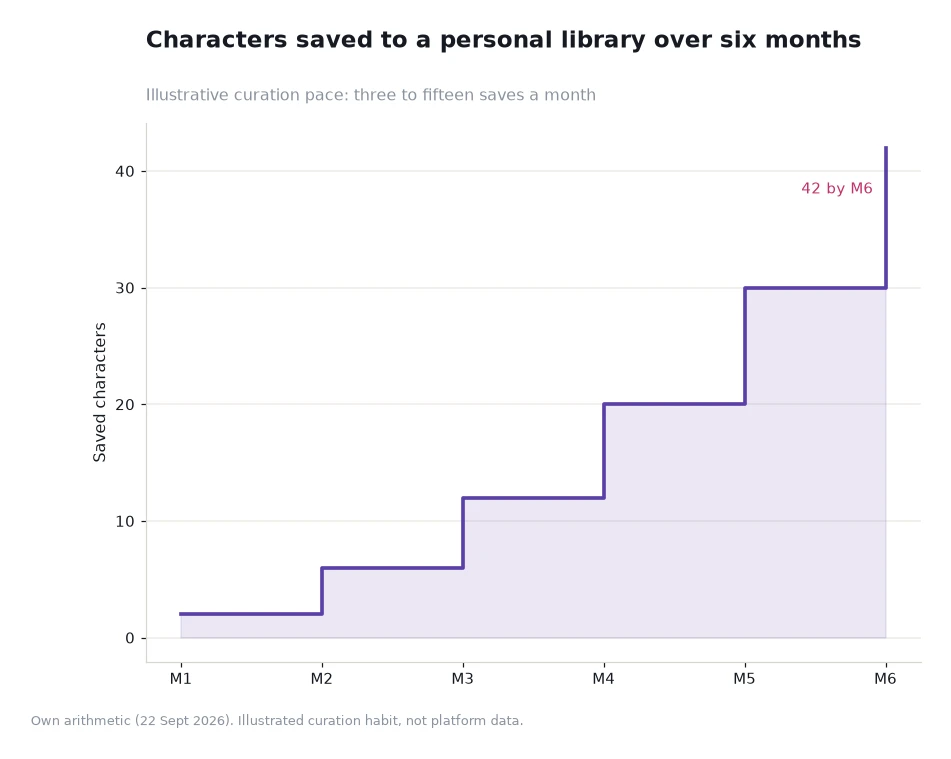
- Saves accumulate the same way on either surface — 2, 6, 12, 20, 30 and 42 across six months under one illustrative pace.
The difference between a surface and a record
Stop thinking of a browser tab and an app as two products. Both are surfaces for the same account, and the account is where anything worth keeping actually lives. That framing resolves most of the confusion in this comparison: if it belongs to the account, it survives a closed tab; if it belongs to the window, it does not.
A browser tab holds one thing the account does not: the immediate state of the visit. An unsent draft, a line of thought, the position of a conversation. That is genuinely convenient and genuinely fragile, because tabs are closed by accidents, restarts and memory pressure.
An app is built around the assumption that people leave and come back. The platform offers a mobile app on iOS, published as CrushMash in the App Store, plus an Android download, so a phone session is a normal part of the product rather than an improvisation.
What travels, and what is lost
Anything the account owns travels. Saved characters travel. The library travels, with the same 42 entries visible on a phone and on a laptop under the illustrative six-month curve below. Preference recall travels as well, which is the point of the platform's description that companions remember your preferences.
What does not travel is the transient state of a window. Two tabs open on two different characters means two places to be, and closing one of them ends that visit without touching the other. Nothing is damaged; the visit simply ends earlier than intended.
The practical cost of that loss is small in absolute terms but worth sizing. At three sessions a week — twelve a month — losing a tab mid-visit costs at most the remainder of that visit, which is somewhere between 15 minutes and an hour depending on the session length you keep.
One further difference affects habit rather than data. Tabs invite parallel browsing: three windows open, three characters, none of them finished. An app encourages one session at a time, which is a small constraint and a useful one, since the triage habits that keep a library sane depend on finishing what you start.
| Element | Browser tab | App session | What decides persistence |
|---|---|---|---|
| An open conversation | Lost if the tab closes | Better suited to interruption | The surface itself |
| Saved characters | Follow the account | Follow the account | The account |
| Library of saves | Identical on both | Identical on both | The account |
| Preference recall | Available when signed in | Available when signed in | The account |
| Tidiness | Tabs multiply across a week | One icon, one place | Your own habits |
| Quick check-ins | No install needed | Faster after the first setup | How often you visit |
Worked example: a library that ignores the window
Because saves attach to the account, the library curve is the same whichever surface produces it. Take an illustrative pace of two saves in month one and then four, six, eight, ten and twelve added afterwards: the running totals go 2, then 6, 12, 20, 30 and finally 42.
Twelve lost tabs across those six months would change nothing in that sequence, because a lost tab was never part of it. What a lost tab costs is time — at most the remainder of one visit — while what a saved character costs is nothing at all once it is in the library.
The asymmetry explains why the surface debate is smaller than it first appears. Forty-two saved characters represent perhaps a few hours of accumulated decisions; one closed tab represents minutes. Sorting out which of those two numbers matters is most of the decision.
Testing persistence on your own device
The reliable way to settle the question is a two-minute experiment rather than a paragraph of theory. Begin a session in a browser tab, note something specific, close the tab, reopen the platform and check what is still there. Then repeat in the app: start a conversation, leave it, return an hour later and see where it resumes.
That experiment also tells you how much the difference is worth to your own habits. The page at https://crushon.ai/ai-porn-chat is the right starting point, since it describes the product's own position on privacy and on recall — Porn Chat AI and AI Porn Chat being two labels for the same category there — and recall is exactly what a resumed session depends on.
Crushon's other surfaces are worth a look for the same reason. The character search page works the same on both, and the AI chat blog is a better guide to session habits than any general rule about browsers or apps.
Choosing a surface by the shape of your week
Frequency decides more than preference. A reader who visits twice a week is well served by a browser tab, because the setup cost of an app buys nothing back at that volume. A reader who opens a session on most evenings gets more from an app, simply because an icon is a shorter path than a bookmark and a sign-in.
Session length matters too. Long, deliberate visits suit a desk and a large screen; short check-ins suit a phone. Since saves and recall follow the account, there is no penalty for using both, and most readers settle into a mixed pattern within a fortnight without deciding anything formally.
The one habit worth guarding is the same on either surface: close sessions deliberately rather than leaving them scattered. A library of 42 saves stays useful; a dozen abandoned tabs do not, and neither does a habit of starting characters you never return to.
Frequently asked questions
Does the app and the browser show different libraries?
No. Saves, libraries and preferences belong to the account, so the same entries appear on either surface once you are signed in.
What is actually lost when a tab closes?
Only the visit in progress — the unsent draft and the position of a conversation. Under normal use that is somewhere between 15 minutes and an hour of one session.
Which surface is better for long sessions?
Whichever survives your interruptions. If you move between rooms, an app is easier to resume; if you sit down deliberately for an hour, a browser tab is perfectly adequate.
Pick the surface you will actually resume
Run the two-minute test once, then choose the surface that fits the way you visit rather than the way you would like to visit. Saves will follow you either way, and the only thing genuinely at stake is how gracefully a session handles being interrupted.
Data and sources: the product wording, app availability and card structure published on CrushOn.AI[1], read 22 Sept 2026. The six-month save curve, the session counts and the lost-tab estimates are illustrative assumptions, not platform data. Written for readers of adult age, 18 or older.