Risk Review: Planning quality checks for medical consumables
Medical consumables cover products with different intended uses, materials, users, and regulatory pathways. A useful quality plan begins by identifying exactly what is being purchased and where it will be used, then links risks to documented acceptance criteria and lot-level evidence. Buyers should distinguish routine visual checks from specialized testing and qualified regulatory review.
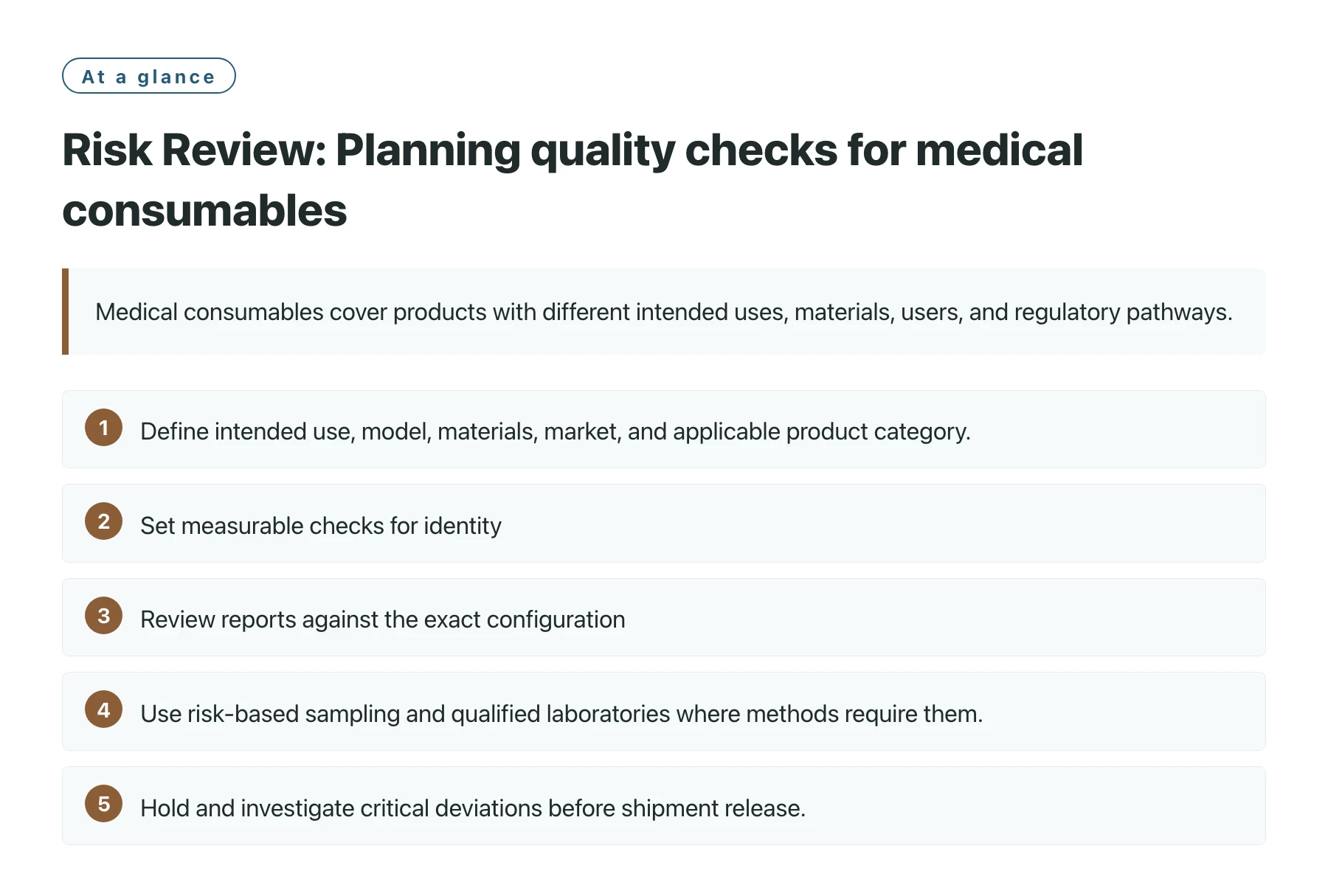
Key takeawaysDefine intended use, model, materials, market, and applicable product category. · Set measurable checks for identity, function, packaging, labeling, and lot traceability. · Review reports against the exact configuration, factory, revision, and market. · Use risk-based sampling and qualified laboratories where methods require them. · Hold and investigate critical deviations before shipment release.
Quality checks are meaningful only when they test the right product, against the right criteria, for the intended use and destination market.
1. Identify the product and its intended use
Record product name, model, intended user, care setting, use frequency, contact type, sterilization status if relevant, dimensions, materials, accessories, and destination market. Terms such as consumable, clinical, or medical grade do not by themselves establish a regulatory category or performance level.
Have a qualified product or regulatory owner confirm classification and applicable requirements for the market. FDA explains that imported medical devices must meet applicable U.S. requirements when a product is a medical device; the requirements depend on product type and responsible parties. This reference does not classify every consumable. [1]
2. Build a product-specific risk map
List plausible failure modes: incorrect identity, contamination, material variation, breakage, leakage, poor fit, unreadable labeling, damaged sterile barrier, or expired shelf life. Rank each by potential harm, likelihood, detectability, and downstream consequence. Use the assessment to decide what to inspect, test, document, or escalate.
Separate critical safety or regulatory criteria from cosmetic preferences. A low-risk appearance defect should not receive the same response as a compromised sterile barrier or a wrong material. Identify which findings stop shipment and who can authorize disposition.
3. Control the specification and approved sample
Use a revision-controlled specification with material, dimensions, construction, function, packaging, label fields, shelf-life conditions, and acceptance limits. Identify the legal manufacturer, actual production site, model, lot coding, and approved packaging version. Attach drawings or photographs where words alone can be interpreted differently.
Keep a signed reference sample or controlled image set and state its status. Confirm whether it is prototype, engineering sample, or production-intent. If design or supplier changes occur, document review and approval before the changed product is accepted as equivalent.
4. Review incoming materials and supplier controls
Ask how materials and components are identified, received, inspected, stored, and linked to finished lots. Request supplier declarations or test reports that name the relevant material, product, site, method, date, and scope. Check whether critical inputs come from approved sources and how substitutions are controlled.
Review process controls for cleanliness, assembly, sealing, curing, or other product-specific steps. A supplier overview is not proof that each batch followed the process. Trace a sample lot through material receipt, production, inspection, release, and shipment documentation.
5. Inspect appearance, identity, and function
Define checks for model and label identity, dimensions, workmanship, visible contamination, closure, leakage, fit, handling, and essential function as applicable. State the inspection location, lighting or setup, tools, sample selection, and acceptable result. Use objective criteria and example images for subjective checks.
A visual sample inspection cannot establish microbiological safety, biocompatibility, sterility assurance, shelf life, or every functional claim. These require appropriate methods and qualified evaluation when applicable. Record what was not tested so downstream decision makers do not overread a basic inspection pass.
6. Verify packaging, labeling, and shelf-life information
Check primary and secondary packaging, seals, barriers, carton protection, storage conditions, lot or serial code, manufacture or expiry date, warnings, instructions, language, and required market identifiers. Tie the reviewed label to the exact product and destination. Confirm print quality and scan barcodes where operationally necessary.
For products represented as sterile, inspect the specified sterile barrier and package integrity criteria, while recognizing that visual inspection alone does not validate a sterilization process. If shelf life or environmental claims matter, confirm the underlying evidence and packaging configuration with qualified reviewers.
7. Define sampling and specialized test requirements
Specify the lot definition, sample size, test method, acceptance number or limits, instruments, and reporting format before production begins. Choose sampling based on risk, history, lot size, and contractual requirements. Do not assume one generic sampling rule fits all characteristics or product classes.
Use a competent laboratory for chemical, physical, microbiological, biocompatibility, or performance tests when needed. Confirm that the method and report scope cover the exact model, materials, configuration, and market. Record chain of custody and preserve samples where a later investigation may be required.
8. Review evidence and traceability
Match certificates, declarations, registrations, test reports, and approvals to manufacturer, site, product code, revision, market, and date. Check scope, issuing organization, limitations, and whether any changes occurred after testing. Registration, listing, or a quality certificate should not be represented as universal product approval.
Require lot-level traceability from material sources through finished goods and shipment. Reports should identify order, lot, sample basis, method, result, inspector, date, and deviations. Store the evidence where procurement, quality, regulatory, and receiving teams can retrieve it.
9. Manage deviations and release decisions
For a failure, contain the affected lot, identify potentially related orders, investigate root cause, define correction, and verify effectiveness. Record whether goods were sorted, reworked, replaced, or rejected. Require documented approval for any concession, with scope and risk review stated.
Shipment release should require completion of critical checks, required documents, and open actions. Buyers arranging medical supplies sourcing should align the product specification, supplier evidence, inspection scope, and market review before purchase. Reassess the plan when intended use, material, site, process, packaging, or market changes.
Sources
Frequently asked questions
Does every medical consumable need the same inspection plan?
No. Intended use, risk, product type, market rules, supplier history, and failure consequences determine appropriate checks.
Can visual inspection confirm sterility?
No. It may identify visible packaging defects but does not validate sterilization or microbiological safety.
What should a medical supply test report identify?
Product and revision, manufacturer and site, method, sample basis, date, results, limits, and report scope.
Does supplier registration mean a product is approved?
Not necessarily. Verify the relevant market pathway, product identity, status, and applicable evidence with a qualified reviewer.